- TypeScript 100%
| .github/workflows | ||
| docs | ||
| extensions | ||
| src | ||
| tests | ||
| .gitattributes | ||
| .gitignore | ||
| biome.json | ||
| LICENSE | ||
| package-lock.json | ||
| package.json | ||
| README.md | ||
| tsconfig.json | ||

pi-dynamic-workflows



Claude Code–style dynamic workflows for Pi. Turn one prompt into a fleet of subagents that fan out in parallel, cross-check each other, and hand back a single synthesized answer.
Website · npm · Pi package · GitHub
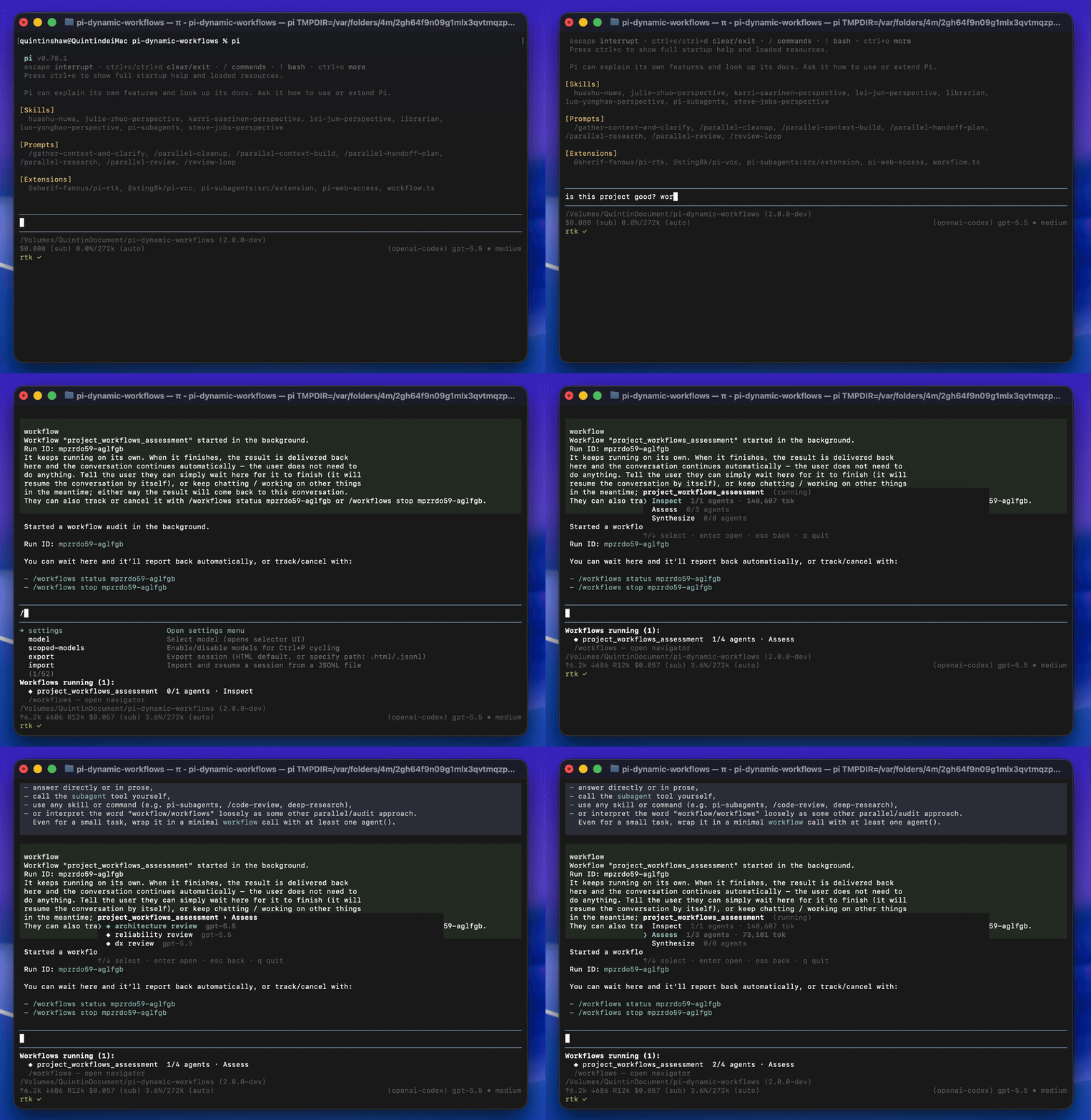
Instead of one model grinding a task step by step, Pi writes a small JavaScript orchestration script that spawns many subagents at once, keeps the intermediate work in script variables (not your chat context), and returns only the result. It's the "code mode for subagents" from Claude Code — on any model Pi can reach.
Built for codebase-wide audits, multi-perspective review, large refactors, and cross-checked research — anything one context window can't hold.
Install
pi install npm:@quintinshaw/pi-dynamic-workflows
Then /reload in Pi. You get the workflow tool plus the /workflows, /deep-research, and /adversarial-review commands.
Try it
Ask in plain language:
Run a workflow to audit every route under src/routes/ for missing auth checks.
Pi writes the script and runs it in the background — your turn ends immediately and a live panel tracks progress while you keep working. Substantive interactive requests auto-arm workflows by default, even if you never type workflow or run /effort. Add the word noflow anywhere in a message for a one-shot opt-out; slash commands and terse/trivial messages are left alone. /effort off disables automatic substantive-message forcing for the session, while /effort high and /effort ultra restore/raise it. You can still type workflow or workflows to force keyword mode for short prompts; /workflows-trigger off|on|status controls only that keyword trigger.
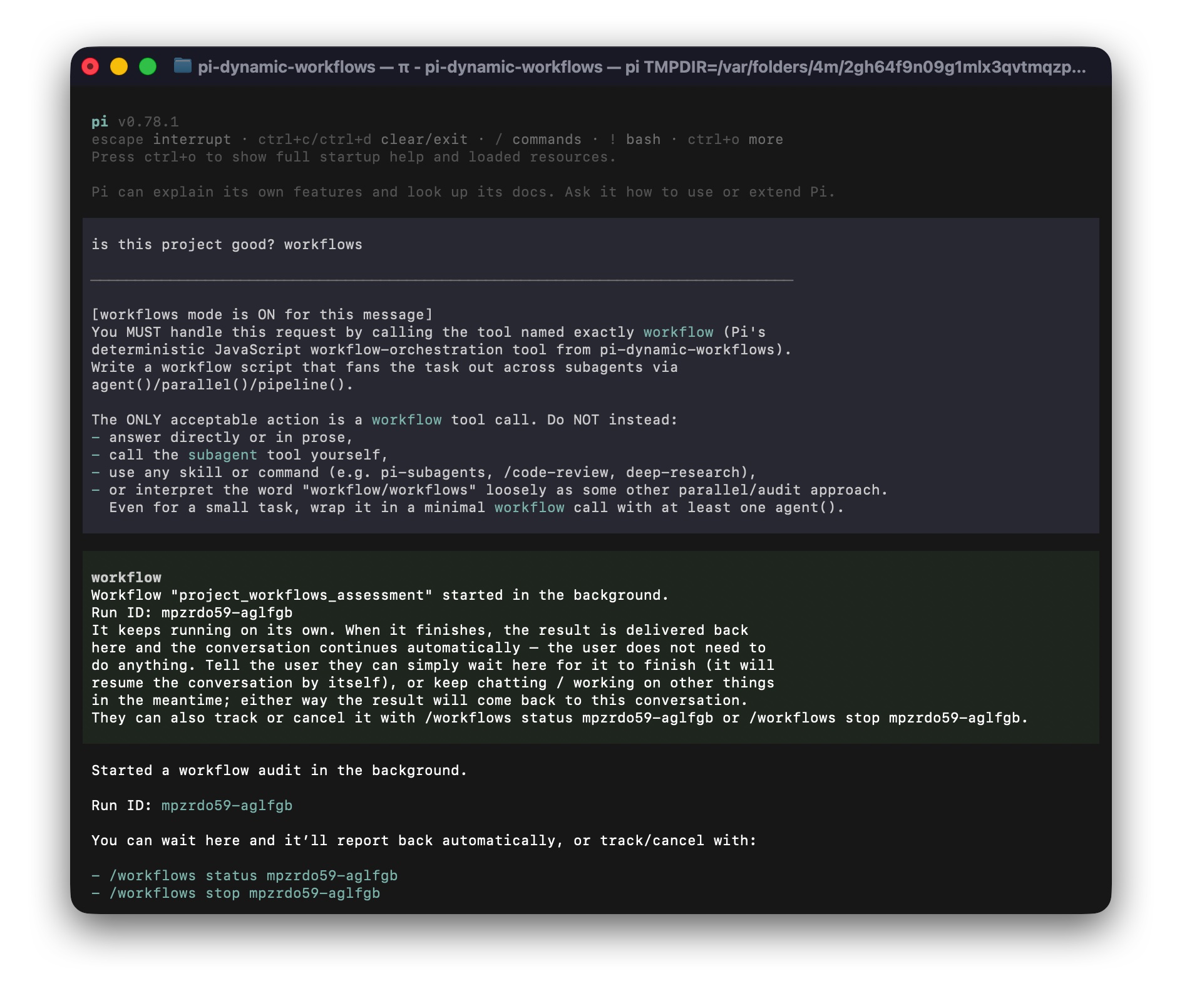
If another Pi extension has already installed a custom editor component, pi-dynamic-workflows leaves it in place and keeps the submit-time workflow trigger active. In that compatibility mode, the animated keyword highlight and Backspace keyword-disarm affordance are skipped because the existing editor remains responsible for rendering and input handling; add noflow to a message or use /effort off when you need to discuss a substantive task without auto-triggering. Editor composition is load-order dependent: whichever extension installs a visual editor last owns the editor surface, while pi-dynamic-workflows still keeps its submit-time hook registered.
What a workflow looks like
Plain JavaScript. The first statement exports literal metadata; then you orchestrate:
export const meta = {
  name: 'auth_audit',
  description: 'Find routes missing auth checks and verify them by using the app',
  phases: [
    { title: 'Scan' },
    { title: 'Review' },
    { title: 'Antagonistic Code Review' },
    { title: 'Use Verification' },
    { title: 'Synthesize' },
  ],
}

phase('Scan')
const files = await agent('List every route file under src/routes/.', { tier: 'small', label: 'route inventory' })

phase('Review')
const findings = await parallel(
  files.split('\n').filter(Boolean).map((file) =>
    () => agent(`Audit ${file} for missing auth checks.`, { tier: 'medium', isolation: 'worktree', label: `audit ${file}` }),
  ),
)

phase('Antagonistic Code Review')
const review = await agent(
  'Act as an independent skeptical/hostile reviewer. Inspect the audit findings for bugs in reasoning, security issues, regressions, missing tests or missing evidence, and whether the workflow satisfied the user request. Because this workflow did not change code, perform the analogous artifact/answer review and note that patch code review is not applicable. Later phases must fix or explicitly rebut every finding.\n\nFindings:\n' + findings.join('\n\n'),
  { tier: 'medium', label: 'hostile review' },
)

phase('Use Verification')
const verification = await agent(
  'Use the actual application non-destructively to verify representative auth findings and address the antagonistic review. Start the app if needed, exercise protected routes with unauthenticated/test requests (for web UI/API use Playwright and capture screenshots), and report concrete evidence. Do not rely only on code review, unit tests, or verify().\n\nFindings:\n' + findings.join('\n\n') + '\n\nAntagonistic Code Review:\n' + review,
  { tier: 'medium', label: 'app verification' },
)

phase('Synthesize')
return await agent('Synthesize the findings, Antagonistic Code Review, and real app-use verification evidence. Fix or explicitly rebut every review finding before concluding.\n\nFindings:\n' + findings.join('\n\n') + '\n\nAntagonistic Code Review:\n' + review + '\n\nVerification:\n' + verification, { tier: 'big', label: 'final synthesis' })
agent() spawns an isolated subagent, parallel() runs many at once, phase() groups them in the live view, and tier routes each one to the right model. That's the whole idea.
Highlights
- Fan-out orchestration —
agent(),parallel(),pipeline(),phase()in a sandboxed script. Up to 16 concurrent / 1000 total subagents; intermediate results stay in variables, not the chat. - Real model routing —
small/medium/bigtiers (or an exactmodel) per agent. It actually switches the subagent's model — cheap work on a light one, hard synthesis on a big one. - Automatic self-recovery — if a foreground or background workflow fails, a guarded diagnosis workflow inspects the failed script, args, logs, error, and agent failures once; recoverable runs are rewritten and rerun automatically, while unrecoverable runs surface a clear explanation.
- Journaled resume — an interrupted run replays finished agents from a journal (no re-run, no tokens) and runs only what's left or what you changed.
- Git worktree isolation —
isolation: "worktree"gives an agent its own branch, so parallel agents can edit the same files without clobbering each other. - Real token & cost accounting — read from each subagent's session, not estimated.
budgetgates on the real total and/workflowsshows the dollar cost. - Background by default — the turn ends right away, a live "Workflows running" panel tracks runs, and each result is delivered back so the conversation auto-continues when it finishes.
- Interactive
/workflowsTUI — drill runs → phases → agents → detail; inspect per-agent failures and compact subagent history; pause, stop, restart, and save runs from the keyboard. - Quality patterns built in —
verify(),judgePanel(),loopUntilDry(), andcompletenessCheck()for adversarial review, best-of-N, and exhaustive discovery. - Default auto-workflows — substantive interactive messages auto-arm a thorough multi-agent workflow by default. Add
noflowfor one message,/effort offfor the session, or/ultracode//effort ultrafor exhaustive fan-out. - Bundled
/deep-research+/adversarial-review— real web search, source cross-checking, and cited reports. - Saved & nested workflows — turn any run into a
/<name>command, and compose saved workflows from inside other scripts.
How it maps to Claude Code dynamic workflows
The same model — on Pi, plus the production pieces a real run needs:
| Claude Code dynamic workflows | pi-dynamic-workflows (on Pi) |
|---|---|
| Code-mode orchestration — the model writes a script that drives subagents | A JS workflow tool running agent() / parallel() / pipeline() / phase() in a vm sandbox |
| Subagents with isolated context | Fresh in-memory Pi sessions; results held in script variables, not the chat |
| Structured outputs | JSON-Schema schema → a validated object, with bounded repair if the model misses |
| Background runs | Non-blocking by default, a live task panel, and auto-continue delivery |
| Resume | Journaled + replayable — survives restarts and replays the unchanged prefix |
| Model selection | Per-agent / per-phase routing across any provider Pi is authenticated for |
| Ultracode / automatic orchestration | Substantive prompts auto-arm workflows by default; /ultracode (or /effort ultra) raises that to exhaustive fan-out, while noflow or /effort off opt out |
| — | Git worktree isolation, real cost accounting, /deep-research, and a quality-pattern stdlib |
Commands
/workflows                  open the interactive navigator (plain list in print mode)
/workflows status <id>      watch a run live; print its result when it finishes
/workflows save <name>      save the latest run's script as a reusable /<name> command
/workflows pause|resume|stop|rm <id>
/workflows-trigger off|on|status
                            disable, restore, or inspect only the workflow/workflows keyword trigger
/workflows-models           map the small / medium / big tiers to real models
/ultracode [off]            raise automatic workflows to exhaustive fan-out; off disables them
/effort off|high|ultra      control substantive-message auto-workflows (default high; off disables)

/deep-research <question>   web-researched, source-cross-checked report
/adversarial-review <task>  findings vetted by skeptical reviewers
In the navigator: ↑/↓ select · enter/→ open · esc/← back · p pause · x stop · r restart · s save · q quit. Each agent shows the model it ran on; the detail view shows its prompt, result, error diagnostics, and compact message/tool history.
Reference
The full guide — every global, agent option, agentType definitions, structured output, and determinism — lives on the website. The essentials:
Non-trivial workflows that implement, change, or draft code or code-like artifacts must include an Antagonistic Code Review phase/stage in meta.phases as { title: 'Antagonistic Code Review' }, call phase('Antagonistic Code Review'), and run an independent skeptical/hostile reviewer agent after the implementation/artifact draft and before Use Verification or final synthesis. The reviewer must inspect changed code, diffs, design, or produced artifacts for bugs, security issues, regressions, missing tests, and whether the workflow satisfied the user request. The workflow must fix or explicitly rebut findings before completion. For no-code workflows, run an analogous antagonistic artifact/answer review or include an explicit note explaining why code review is not applicable.
Non-trivial workflows that implement, change, or verify application behavior must include a Use Verification phase/stage in meta.phases and run an agent() there that uses the actual application or system non-destructively. Code review, tests, or verify() alone are not enough. Use the right modality: TUI apps via tmux, web pages via Playwright with captured screenshots and image analysis, GUI apps via computer-use under xvfb with screenshots/images and an image gate, and other apps via equivalent real use. If verification would be destructive and no non-destructive or sandbox option exists, the workflow must include an explicit skipped-verification agent explaining why.
Workflows that make intentional file changes in a git-tracked project should normally include a final Commit & Push Gate phase/stage after Antagonistic Code Review and Use Verification have passed; declare it in meta.phases as { title: 'Commit & Push Gate' }, call phase('Commit & Push Gate'), and run an agent() that checks git status/diff, determines the repo is owned or are authorized to push, runs a leak/secret check over all changes (for example, gitleaks protect --staged or equivalent before commit/push), then performs a normal commit and push only if all gates pass. It must not commit or push when the user said not to, there are no intentional changes, ownership/push authorization is unknown or absent, review/verification failed or has unresolved findings, the action would be destructive/unwanted, or the leak/secret check fails; instead leave changes uncommitted/unpushed and explicitly report why.
| Global | What it does |
|---|---|
agent(prompt, opts) |
Spawn an isolated subagent. Returns its final text, or a validated object with opts.schema; recoverable failures return null with diagnostics in /workflows. |
parallel(thunks) |
Run () => agent(...) thunks concurrently; results in input order. |
pipeline(items, ...stages) |
Fan items through sequential stages (prev, original, index). |
phase(title, { budget? }) |
Group agents in the live view; optional per-phase token sub-budget. |
verify / judgePanel / loopUntilDry / completenessCheck |
Built-in quality patterns. |
workflow(name, args) |
Run a saved workflow inline (shares the global caps). |
checkpoint(prompt, opts) |
A journaled, replayable human approval gate. |
budget |
{ total, spent(), remaining() } real-token tracker. |
| Agent option | Description |
|---|---|
tier |
"small" | "medium" | "big" — coarse model routing (configure via /workflows-models). |
model |
Exact provider/modelId (always wins over tier). |
agentType |
A named definition (.pi/agents/<name>.md) binding tools + model + role prompt. |
isolation: "worktree" |
Run in a throwaway git worktree for conflict-free parallel edits. |
schema |
JSON Schema → the subagent returns a validated object. |
label / phase / timeoutMs |
Display label / phase override / per-agent timeout. |
Workflows run in a Node vm sandbox; Date.now(), Math.random(), new Date(), and require/import/fs/network are unavailable, so runs stay reproducible — which is what makes resume reliable.
When a run fails for a non-abort reason, the manager makes one conservative automatic recovery attempt by default. Recovery itself is a small workflow-runtime run that asks a diagnosis agent for a structured decision and, only when recoverable, executes the corrected workflow. Stop, pause, Esc/user aborts, and corrected-workflow failures do not recurse into additional recovery attempts; /workflows shows the recovery status and reason alongside the run.
Computer-use verification
The package also registers GUI computer-use helpers for workflow Use Verification phases:
computer_use_probechecks forgimp,xvfb-run/rawXvfb/DISPLAY,xdotool, ImageMagick,python3, and Pillow.computer_use_gimp_gauntletlaunches GIMP in an isolated Xvfb/existing-display session, drives it withxdotool, captures before/after screenshots, analyzes the image delta, and writes JSON/Markdown reports.
Artifacts default to .pi/workflow-artifacts/computer-use/<run-id>/, which is ignored by this repo. Missing native dependencies produce a clear skipped result by default instead of failing the whole workflow. See docs/computer-use.md for details.
Development
npm install
npm test              # biome + tsc + unit tests
npm run test:gauntlet # optional native GUI gauntlet; skips clearly if GIMP/Xvfb deps are missing
Every feature is also verified end-to-end against a real Pi subagent session before release.
Credits
The "code mode for subagents" idea comes from Michael Livs' original pi-dynamic-workflows and Anthropic's dynamic workflows in Claude Code. This project builds on it with real model routing, journaled resume, git-worktree isolation, cost accounting, an interactive TUI, and deep research.
License
MIT — see LICENSE.